


Theodoridou Evangelia
How to build a social media marketing strategy in 2026
Benefits, strategy and trends for 2026
If you're still wondering whether social media marketing is worth the effort, the answer is simple. It is. In fact, it's one of the most powerful tools available to any business owner, marketer, or brand manager today. But for it to work, you need a strategy, not random posts. In this article, we'll look at what social media marketing is, what its real benefits are, what advantages it offers compared to other channels, and how to build a complete strategy from scratch.
What is social media marketing?
Social media marketing is the use of social networks (Facebook, Instagram, LinkedIn, TikTok, YouTube, X (formerly Twitter), Pinterest, and others) to promote products or services, strengthen a brand's recognition, and achieve specific business goals. We're not just talking about “posting photos.”
- Organic content (posts, stories, reels, video)
- Community management & customer care
- Social listening & competitor analysis
- Analytics & optimization
Social media marketing is an entire communication ecosystem between a brand and its audience, which, when applied correctly, builds awareness, trust, leads, and sales.
Social media marketing doesn't replace your other channels. It strengthens them. It works best as part of a broader digital marketing mix.
What are the benefits of social media marketing?
Why do so many businesses invest in social media marketing? Because the benefits are measurable, specific, and proven.
Increasing brand awareness and website traffic
Social media gives you the ability to be “heard” and appear in front of a far larger audience than almost any other channel could offer you. According to 2025 data, 65.7% of the global population actively uses social media, while the average user visits 6-7 different platforms every month. This means social media isn't just a promotional channel but a key touchpoint between your brand and the audience you want to reach. By using links in your posts, you can increase traffic to your site. At the same time, the more users see, remember, and search for your brand, the more your direct visits indirectly increase as well. Moreover, when users comment on your content, share it, or mention you, they help increase its reach. These actions shouldn't be treated merely as engagement metrics, but as real opportunities for more people to get to know your brand. Now, with the rise of AI, content published on certain social media platforms, such as Reddit, can also be used by LLM tools. This means that if your business creates the right, strategic content that answers real user questions, there's a chance that in the future AI chatbots will surface answers based partly on your own content. In short, the content you build on social media today can influence not only the traffic to your site but also how your brand appears when users search for answers, whether on Google or in AI tools.
Direct communication with your audience
Unlike television or banner ads, social media allows two-way communication. The customer can comment, share content, and ask whatever interests them, and you, as a brand, can respond in real time and build a relationship of trust.
Generating leads and sales
In 2025, sales through social media already account for 17% of all online sales, and the social commerce market is expected to reach 1 trillion dollars globally by 2028. Businesses with a flexible social media marketing strategy gain a competitive advantage.
Competitor analysis
Social media gives you access to real-time data on what your competitors are doing, what content they create, how much they experiment with trends, which audience they target, and where they invest. This information is irreplaceable for making strategic decisions.
How to build a social media marketing strategy from scratch
Constantly posting content based only on trends or content that has no strategy doesn't build your brand and doesn't bring quality results. Brands that succeed on social media know in advance what they want to achieve, who they're speaking to, and what message they want to convey. Every post has a purpose (to build recognition, drive people to the site, or lead to a sale). By contrast, anyone who posts “just to post” simply fills the feed with no direction. The difference, then, isn't how often you post, but whether there's a clear plan behind it.
Set measurable goals (SMART Goals)
Every strategy starts with goals. “Let's become well-known” isn't a goal, it's a wish. A SMART goal is “Increase our Instagram followers by 20% in 3 months.”
Analyze your target audience (Buyer persona)
Before you create any content, you need to think about who you're addressing as a brand. What are their demographic characteristics and behavior? What is their age, profession, and interests? What concerns them, and what do they want to achieve? The clearer the picture you have of your target audience, the more easily you'll create content that truly interests them. Because when someone feels you're speaking specifically to them, they stop scrolling and listen. By contrast, a message addressed “to everyone” ultimately touches no one.
Be present on the platforms where your audience is
As a business, you don't need to be on every social media platform. Do your research and find where the majority of your audience is, and start by creating content on those platforms.
Publish content that interests your audience
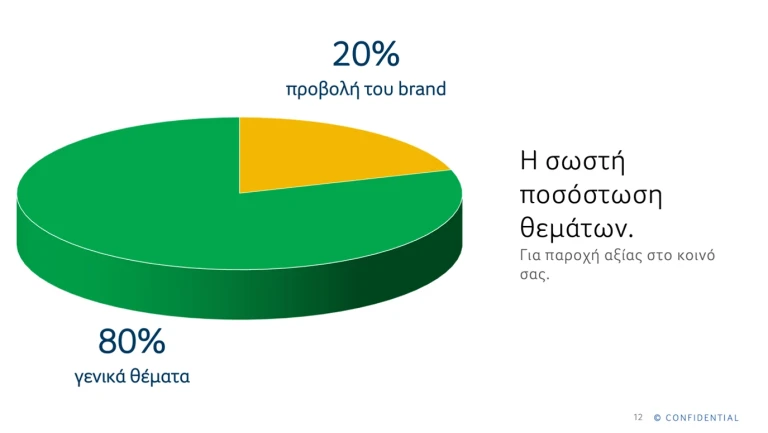
You need a content mix that combines educational content (how-to, tips), entertaining content (entertaining/relatable), promotional content (offers, launches), and social proof (testimonials, case studies). The 80–20 ratio is ideal. 80% content that provides value, 20% content that promotes the brand. Let's see some examples for a business that offers accounting services.
- Educational content: “5 expenses that may be deductible for your business that you might not know about.”
- Entertaining/relatable content: “When you remember on the last day that you need to send the invoices to your accountant.”
- Promotional content: “New monthly accounting service for freelancers, with a fixed cost and online support.”
- Social proof: “How we helped a small business organize its finances and reduce tax errors within 3 months.”
Create a content calendar
A content calendar isn't just organization, it's consistency. And consistency is what builds the algorithm, trust, and an audience. Plan at least 2–4 weeks ahead, with a clear plan for content type, platform, day, and time of posting.
Equally important is the ability to adapt. In cases of crisis or natural disaster (fires, floods, tragic events), stop your scheduled content immediately. Anything celebratory, humorous, or promotional in particular can come across as insensitive and do great damage to your brand. This sensitivity isn't just a matter of image, it's a matter of respect for your audience.
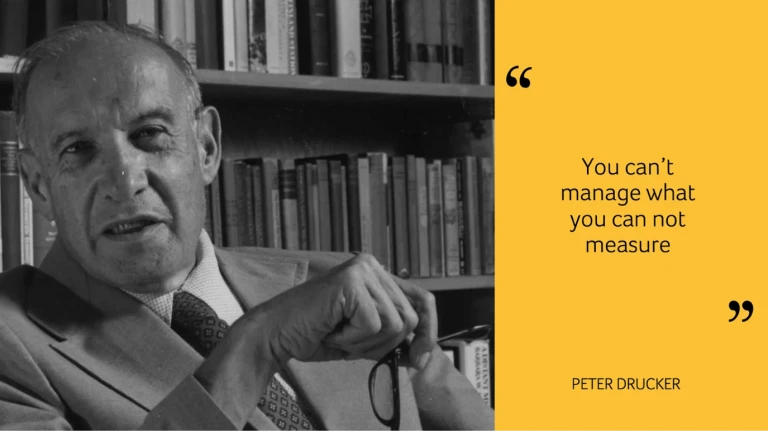
Define specific KPIs and track results in analytics.
A KPI is a specific goal for which we want to see some increase over a period of time. So it's both quantitatively and time-defined.
What do you measure for each KPI you set? It depends on your goal. For awareness: reach, impressions, followers. For engagement: likes, comments, shares, saves. For leads/sales: CTR (click-through rate), conversion rate.
Depending on the format, the metrics worth tracking differ:
- Video: views, average watch time
- Carousel posts: engagement rate
- Static posts: impressions, engagement rate, reach
- Infographics: save, shares, impressions
- Podcasts: streams
Don't look only at vanity metrics. The number of followers means nothing if it isn't accompanied by real interaction and results.
No strategy is perfect from the start. Test different formats (Reels vs. carousel vs. static), different hooks, different audiences. Keep what works, drop what doesn't.
Social media marketing trends in 2026 you need to know
The landscape is constantly changing. These are the trends shaping social media marketing in 2026:
- Use AI as a tool, not as autopilot: AI tools speed up content production, from scripts to ad copy, videos, and images. The key is to use AI to enhance, not replace, your authenticity.
- Use short-form video across every stage of the funnel: YouTube Shorts, Instagram Reels, and TikToks are no longer just an awareness tactic; they now work at every stage of the funnel, from consideration to conversion. The content that performs looks organic and has a fast hook, mobile framing, and simple editing.
- Create authentic material: UGC and creator-led content deliver up to 8.7x higher engagement than traditional branded content. Lo-fi (low fidelity) mobile-shot content, natural lighting, and conversational tone are gaining ground over over-produced videos.
- Social Search: social media as the new search and sales engine: Almost 1 in 3 consumers skips Google entirely and starts their search directly on TikTok, Instagram, or YouTube. This changes how you should write captions, titles, and hashtags. In fact, more and more purchases happen directly inside the platforms, without the user ever needing to visit an external site.
- Optimize community management: Fast response is now a must, especially given the AI chatbots now available that can connect directly to a call center, social media, and on-site chatbots so users are served immediately with no delay. To this day, 3 out of 4 users expect a response from a brand within 24 hours, and if there isn't one, they turn to the competition.
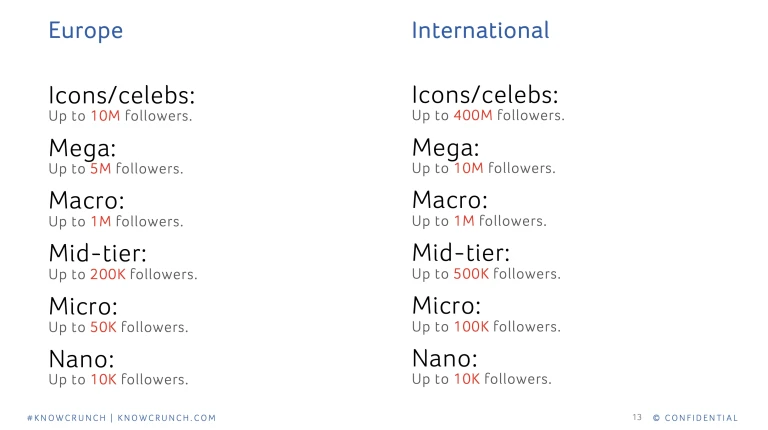
- Partner with micro-influencers: Micro-influencers (10,000–50,000 followers) have an average engagement rate of 3.86%, far higher than mega-influencers. For small and medium-sized businesses, they are the most cost-effective option.
Frequently asked questions
It's the use of platforms such as Instagram, Facebook, TikTok, and LinkedIn to promote a business, service, or product through organic content and communication with the audience.
The main benefits are: increased recognition, direct communication with customers, generation of leads and sales, low advertising cost compared to traditional channels, and the ability to analyze results in real time.
Digital marketing is the umbrella term that includes SEO, email marketing, advertising campaigns, content marketing, social media, and more. Social media marketing is one tactic within digital marketing, focused exclusively on social platforms.
It depends on your audience. If you have a B2C product with a strong visual identity, start with Instagram and TikTok. If you provide B2B services, LinkedIn is the best option. If you have educational content, YouTube pays off in the long run. Before choosing any platform, you should always check whether your audience is actually there, not whether you think it is.
There's no magic number. Consistency is more important than frequency. To start, 3–4 posts/week on 1–2 platforms is realistic and sustainable. Gradually, you increase based on results and your production capacity.
You set KPIs according to your goals: if you want awareness, you measure reach and impressions. If you want engagement, you measure likes, comments, and shares. If you want sales, you measure ROAS and conversion rate. Use each platform's native analytics as well as Google Analytics 4.